Most link building campaigns spend budget before they have a plan. The outreach starts, links get built, and three months later nobody's sure why rankings haven't moved.
A link building plan isn't complicated, but skipping it is expensive.
Here's what this guide covers:
How to build a link building plan step by step, from goals to execution
The right tactics to include and how to measure what's working
A 90-day roadmap you can follow from day one
A useful plan connects the pages you want buyers to find with the articles they read before choosing. That can mean a category shortlist, an independent brand review or a relevant reference inside a practical guide. Start with the buyer's question, then choose the format.
TL;DR
Start with a backlink gap analysis before any outreach begins
Prioritize inner pages (service pages, comparison pages, landing pages), not just the homepage
Choose formats around buyer intent: shortlists, brand reviews and relevant contextual references, alongside useful editorial outreach.
Track referring domains, rankings, and traffic, not just link volume
Use the first 90 days to establish a baseline, complete planned work and review evidence. Search results do not follow a fixed campaign timetable.
How to Create a Link Building Plan Step by Step
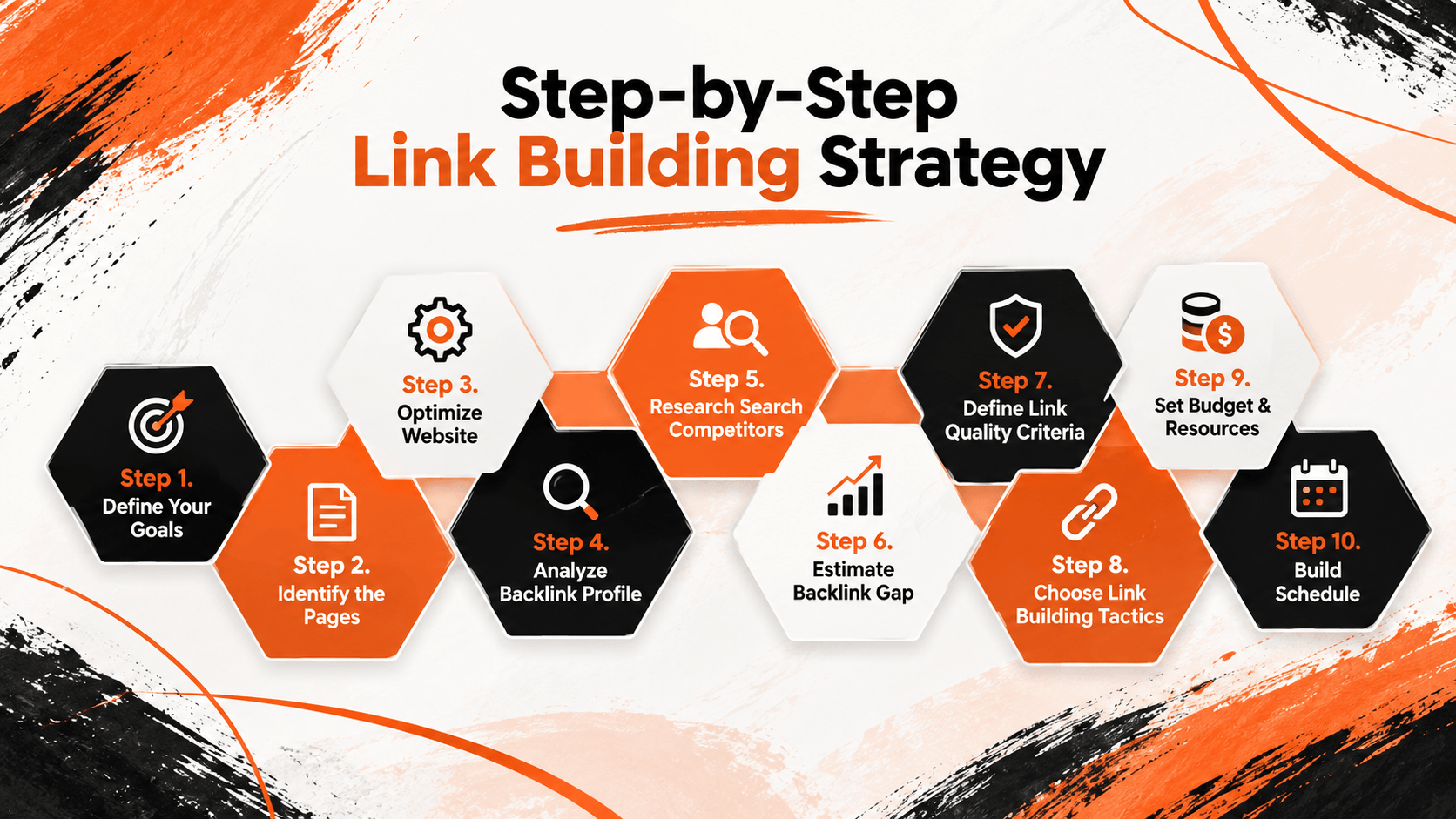
Define Your SEO and Link Building Goals
Before you prospect a single site, know what you're actually trying to achieve.
Ranking a product page for a high-intent keyword looks different from building authority for a new domain. Goals shape how many links you need, where they point, and what quality threshold makes sense for your situation.
For example, a fictional recruitment-software brand might prioritize its agency ATS page and track qualified enquiries alongside search performance. Record the target queries, today's baseline and the next review date. A top-five ranking can be an ambition, not a delivery promise.
Identify the Pages That Need Backlinks Most
Not every page benefits equally from link acquisition. Start by listing the pages that drive the most value when they rank: product pages, service pages, comparison content, and landing pages.
Check current rankings, search intent and conversion data for each page. A page near the first page may deserve attention, but position alone does not tell you whether links, stronger content or technical fixes are the priority.
Don't overlook conversion-focused pages. Blog posts are easy to link to, but your service pages, pricing pages, and bottom-of-funnel content are the ones that directly impact revenue.
Make Sure Your Website Is Ready for Link Acquisition
A link to a thin, slow, or poorly optimized page is a wasted placement. Before outreach begins, confirm that your target pages load quickly, are properly indexed, and deliver what the searcher actually expects.
Check indexability, internal links, mobile usability and whether the content answers the query. Fix obvious gaps before paying for distribution. Links are not a substitute for a useful, accessible page.
Analyze Your Current Backlink Profile
Open Ahrefs or Semrush and pull your current referring domains, anchor text distribution, and which pages already have link equity pointing at them.
This tells you two critical things: where authority already exists, and where the real gaps are. It also flags profile issues like over-optimized anchor text or a backlink profile that's heavily concentrated on the homepage while inner pages have nothing.
Research Your Search Competitors and Their Backlinks
Your competitors' backlink profiles are a ready-made prospecting list. Look at the pages ranking for your target keywords and study where their links come from, what topics those linking pages cover, and what content formats earned those placements.
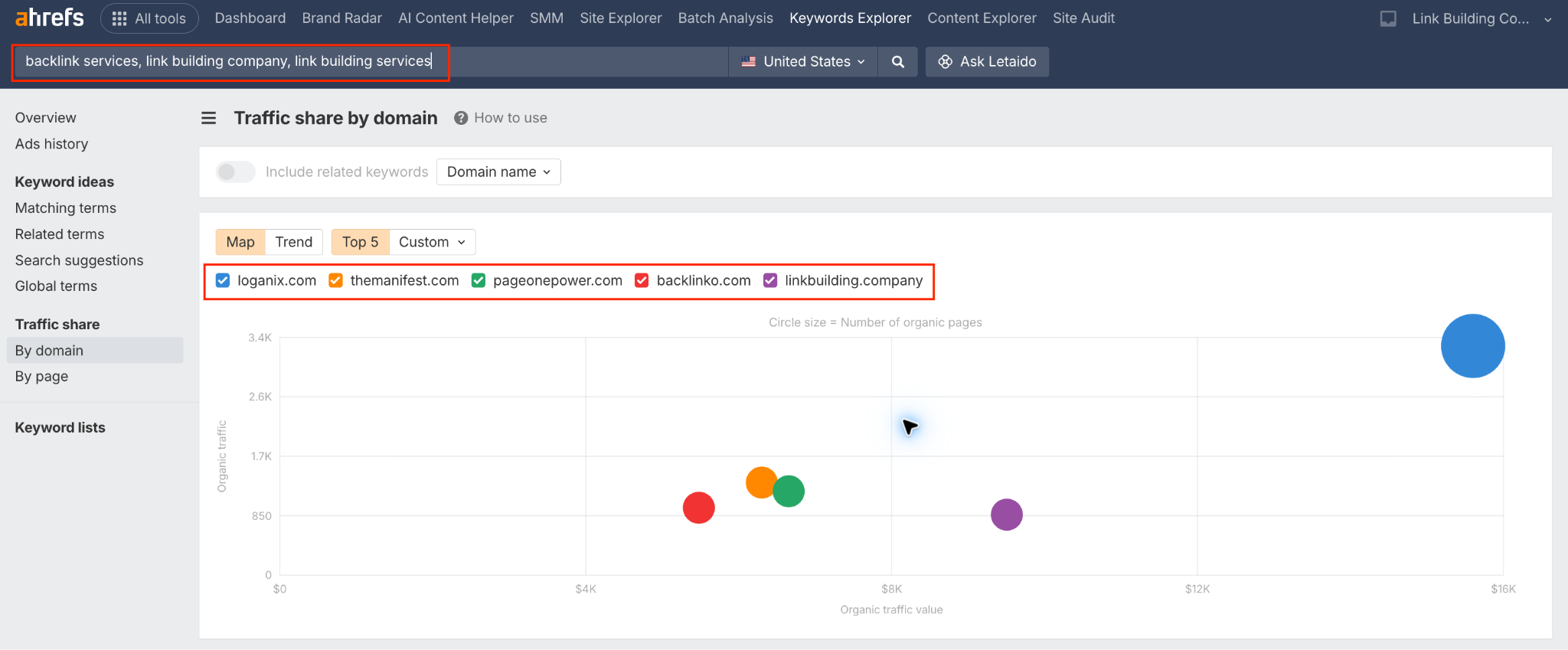
Inspect a few actual linking pages instead of copying a headline industry average. Note why each page references the competitor, whether the same context fits your brand and which claims you could support with evidence.
Estimate the Backlink Gap for Your Target Pages
Take competitor research down to the page level. In an illustrative comparison, one service page might have links from 45 domains and yours from 8. That is a research lead, not a requirement to buy another 37 links. Check the quality and relevance of the linking pages first.
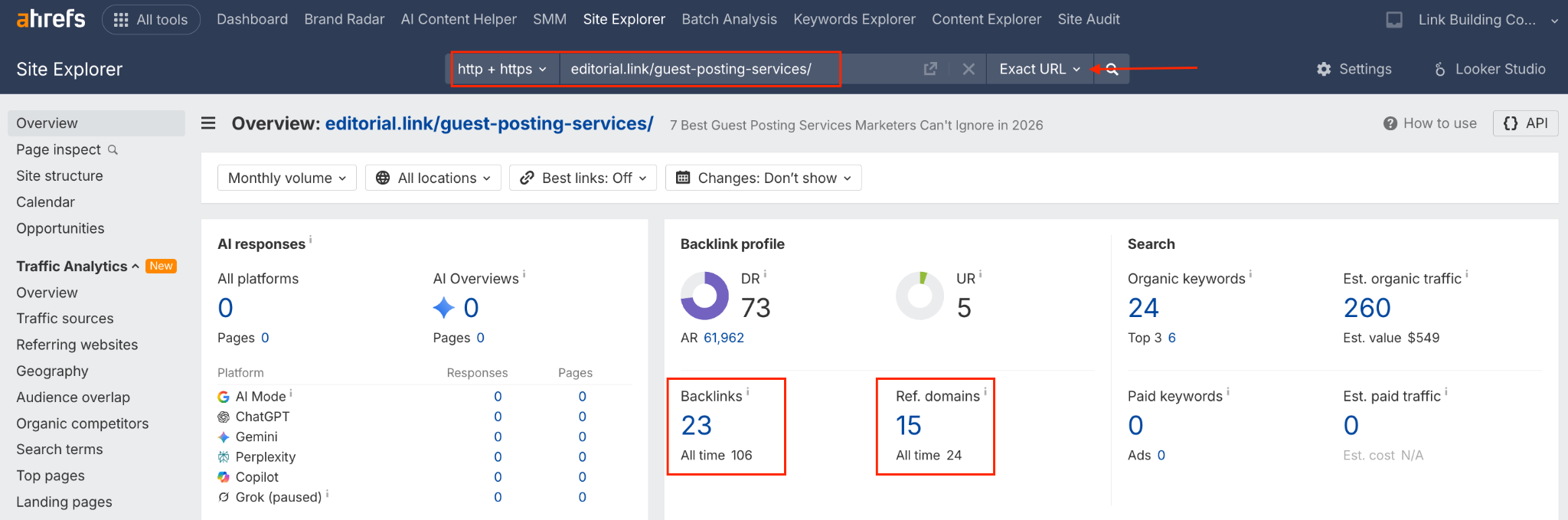
You do not need to match competitors link for link. Use the gap to find missing topics and publisher types, then prioritize opportunities that fit the target page and its audience.
For each priority page, keep a short brief: buyer question, destination URL, relevant article types, approved product facts and the evidence needed to assess a placement. That gives an in-house team or agency a usable starting point.
Define Your Ideal Link Quality Criteria
Set your quality criteria before outreach begins. Review topical fit, editorial standards, the surrounding article, live links and any available traffic estimates. Record the source and date of third-party metrics.
Domain Rating is a third-party comparison metric, not a Google score or a guarantee. Use it alongside page relevance, the site's audience and editorial quality. Consider paid-link policies and appropriate link attributes when evaluating a commercial placement.
Build a review sheet with the proposed article, target URL, reason it fits, metric source and open questions. A metric should support a decision, not replace reading the page.
Choose the Right Link Building Tactics
Match the format to the buyer's question, your budget and the material you can substantiate. Our three services serve different needs:
Brand Listicles: a place among relevant options in a best-of or comparison article. Example: a fictional recruitment tool included in a shortlist for small staffing agencies.
Brand Reviews: a full article about one brand, covering its features, pricing and use cases. Useful when buyers already know the name and want to evaluate it.
Brand Mentions: a short contextual reference with a link in a relevant new or existing article. Example: a guide to handling recruitment workflows naming a tool that supports the task.
Guest posts are new articles written for another publisher; link insertions add a relevant link to an existing article. Digital PR pitches a useful story or original evidence to journalists. These are publishing and outreach approaches, not interchangeable versions of a brand review. Our contextual backlinks guide explains how a reference should fit its surrounding text.
Semantic relevance means considering how the article's subject connects to your page. For example, an agency ATS guide is a clearer audience fit for recruitment software than an unrelated general-interest article, whatever the two sites' DR scores.
Set Your Link Building Budget and Resources
Budget for the work you can review and maintain: research, writing, publisher costs, tools and reporting. Compare the deliverable and audience fit, not only the headline price or DR tier.
If you plan to outsource link building, factor in content creation, outreach management, and reporting. If you're running it in-house, account for tool subscriptions, time cost, and the ramp-up required.
Build a Realistic Link Acquisition Schedule
Schedule work around research capacity, content readiness, budget and publisher availability. A monthly plan helps you manage delivery and learn from it; there is no universally safe link velocity or monthly count that produces rankings.
Map each planned placement to a destination page and a buyer question. Review what was published, whether links still work and how the target pages perform. Separate the delivery schedule from the search outcomes you hope to observe.
A Practical 90-Day Link Building Roadmap
This is an illustrative work plan, not a promise of ranking movement or a required link quota. Adjust it to the size of the site and the resources available.
Days 1 to 30: Establish the Baseline
Choose the priority pages and buyer queries. Record current Search Console clicks, impressions and relevant enquiries, with the date range and definitions.
Fix obvious page and indexing issues. Review competitor references and create a shortlist of suitable topics, article formats and publisher types.
Write an approved brief for each page: product facts, evidence, audience, destination URL and review criteria. Agree the budget and owner.
Days 31 to 60: Create and Review
Prepare accurate product summaries, pitches and supporting material. For a fictional ATS brand, this might be one agency-specific shortlist brief and a factual review outline.
Review proposed articles for reader fit and check live URLs yourself. Use the ChatGPT link-building guide for drafting and organizing research, with source checks and human approval before outreach.
Track work as proposed, in progress or live. Record the destination, surrounding context, link attributes and any agreed delivery terms.
Days 61 to 90: Check and Adjust
Check published URLs, links and factual accuracy. Log corrections or missing deliverables rather than counting everything as complete.
Compare the priority pages with the baseline using equivalent date ranges. Note content updates, seasonality and other changes alongside the placement work.
Choose the next work based on evidence: continue a relevant format, improve a weak page or stop an unsuitable approach. Do not scale solely because a DR score or link count increased.
A Plan in Practice: Jarvi and Agency-Specific ATS Searches
The Jarvi case study shows how one campaign connected a product to specific buyer decisions. Rather than treating every recruitment query alike, the plan used niche ATS shortlists, named-product comparisons and established buyer resources.
The campaign team reports nine niche listicles and 14 alternatives or comparison articles. These are reported delivery counts, not guaranteed outcomes for another campaign.
For the query “best ATS for sales recruitment agencies”, the supplied Google capture from 7 October 2026 showed two campaign articles in the top two organic positions and Jarvi first in the AI Overview.
Other examples distinguish a source being cited from a brand being mentioned. One Perplexity capture included a campaign source without naming Jarvi in its answer.
The planning lesson is to match the audience, decision and article format. These are selected captures and campaign-team reports, not a visibility-rate study or proof that placements alone caused a result. Exact capture dates for several other examples were not recorded.
Common Link Building Planning Mistakes
Here's where most campaigns go sideways:
Building links before the page is ready. Fix indexing, usability and content gaps before directing more attention to a page.
Pointing all links at the homepage. Service pages, product pages, and comparison content often need link equity far more than the homepage does.
Chasing DR over relevance. A DR 75 site with no topical connection to your industry can underperform a DR 45 niche publication that speaks directly to your audience.
Choosing anchors to hit a ratio. Use accurate wording that fits the sentence and linked page. There is no universal anchor mix that guarantees safety or performance.
Planning more work than you can review. Set a manageable schedule with clear ownership. Do not treat a smooth delivery chart as a ranking signal.
Copying competitors without a reason. Use their links to discover opportunities, not as a quota. Check whether the audience and article fit your own business.
Your Plan Is the Strategy, Use It
A plan gives each placement a purpose and makes the work reviewable. Keep the priorities clear enough that someone else can see which buyer question, page and article format each task supports.
Here's what to take with you:
Close the gap first. Understand the distance between your backlink profile and your top-ranking competitors before you spend anything.
Link to your revenue pages. Service pages, product pages, and comparison content convert. Those are the pages worth building authority for.
Choose context over formulas. Match formats and anchor wording to the reader's needs rather than chasing a fixed distribution.
Measure the right things. Referring domains, keyword rankings, organic traffic, and conversions tell the real story. Raw link count does not.
Ready to turn the plan into an order? Choose a package or service, review the total and delivery option, then check out. Provide the project brief after payment and follow the order in your account. Standard delivery is 30 calendar days after payment and complete project details; that is a delivery policy, not a timetable for rankings.
FAQs
How many backlinks do I need to rank on the first page?
There is no universal number. Compare the relevant pages and linking sites for your target query, then consider your content, technical setup and audience fit. A backlink count is a research input, not a first-page threshold.
How long does a link building plan take to produce results?
There is no fixed period for ranking changes. Use a 90-day review to check completed work and compare search performance against a recorded baseline. Competition, site changes and search updates can all affect the result; delivery dates are not ranking promises.
What is a realistic link building budget for 2026?
Start with the deliverable and your budget. At this article's publication, the Spark package is $599 for three placements: one Brand Listicle, one Brand Review and one Brand Mention. Check the current package page for the mix, tiers and total before ordering. Include internal research and review time in your own budget.
Should links go to my homepage or inner pages?
Both, depending on goals. Homepage links build overall domain authority. Inner-page links build authority for specific ranking targets like service pages, product pages, and comparison content. The most effective campaigns distribute links across both, with priority given to the pages that need the most authority to compete.
What is the difference between guest posts and link insertions?
A guest post is a new article on another publisher's site that includes a relevant link. A link insertion adds a relevant reference and link to an existing article. Neither format guarantees editorial control, traffic or rankings. Choose based on context and the publisher's terms, not an assumption that one format is always faster.
Compare packages, then add the one that fits your plan.
3 placements
What’s included
- 1 × Brand Listicles, DR 10 to 29
- 1 × Brand Reviews, DR 30 to 59
- 1 × Brand Mentions, DR 60+
7 placements
What’s included
- 1 × Brand Listicles, DR 10 to 29
- 1 × Brand Mentions, DR 30 to 59
- 1 × Brand Listicles, DR 30 to 59
- 3 × Brand Mentions, DR 60+
- 1 × Brand Listicles, DR 60+
13 placements
What’s included
- 1 × Brand Listicles, DR 10 to 29
- 3 × Brand Listicles, DR 30 to 59
- 1 × Brand Reviews, DR 30 to 59
- 6 × Brand Mentions, DR 60+
- 1 × Brand Listicles, DR 60+
- 1 × Brand Reviews, DR 60+
17 placements
What’s included
- 1 × Brand Listicles, DR 10 to 29
- 4 × Brand Listicles, DR 30 to 59
- 1 × Brand Reviews, DR 30 to 59
- 8 × Brand Mentions, DR 60+
- 2 × Brand Listicles, DR 60+
- 1 × Brand Reviews, DR 60+
Standard delivery: 30 calendar days after payment and complete project details. Review delivery options on the order page.